About 601 Tully

Check out our new website! 601Tully.syr.edu

601 Tully is a center for engaged practice in Syracuse, NY developed by artist and professor Marion Wilson with a rotating collaborative team of 54 students and neighbors and Anda French of French 2Design. It's a site for meaningful exchange between artists, community members, and scholars in the co-production of culture.

601 Tully includes a contemporary art space, a public events space, a bookstore, a teaching garden, and Recess Cafe West.

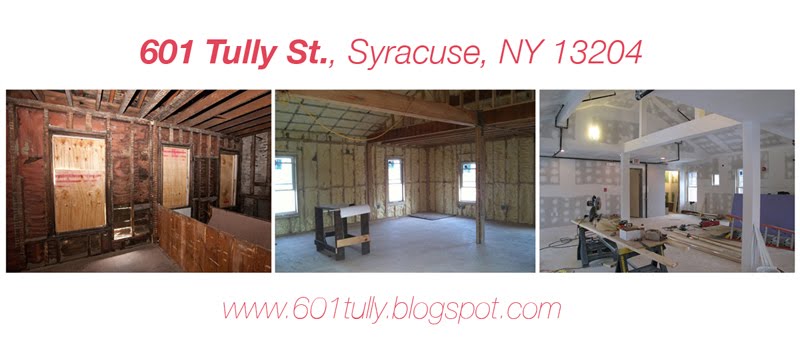
In 2009, Wilson purchased the condemned two-story home and local drug hub, and throughout five semesters, Wilson's design/build class re-zoned, designed, renovated and now sustains the physical and programmatic aspects of 601 Tully. The collaborative team has consisted of artists, architects, environmentalists, Fowler High School students, Green Train Workforce, neighbors, and the occasional passerby.

601 Tully is made possible by the generous support of the Syracuse University School of Education, The Kauffman Foundation, The Near West Side Initiative, Imagining America, Home HeadQuarters Inc., Say Yes to Education, and National Grid.

Find us on Facebook!

Friday, December 10, 2010

Wall


Here is the overall structure in some quick renderings of the panel wall
Thursday, December 9, 2010

Foot Stools and Invented Communities

In 601 Tully I am engaging in a long term systemic project that aligns with my interests in social sculpture, education, and community development. Over the summer I worked for Say Yes to Education in the Blodgett School where I taught art & architecture to 3rd graders. During the semester I teach ESL to refugees in the North Side and also at Nottingham HS. I also teach photography and literacy once a week to students from the South and Near West Sides. In my sculpture and furniture work, I try to focus on systems of production rather than individual pieces. Using exclusively recycled materials I strive to create simple objects that will retain their usefulness in any setting. My hope is that I can establish methods of teaching others to become competent creators who solve their own problems. With my furniture specifically, I display the process of construction rather than hide it. When making conceptual decisions, I use my knowledge of city and its residents to inform my design.

I agree with Miwon Kwon's criticism of contemporary artists' notion of communities. Just as Susan Lacy's piece Full Circle epitomized a “community of mythic unity,” the entire Near West Side Initiative is in danger of making assumptions about the imagined communities it serves. If we assume a loose conglomeration of low-income residents in need of our benevolence we would indeed create a community of “mythic unity” whose response to our efforts would be just as haphazard as the effort itself. If on the other hand we identify a community by its geographical location (the Near West Side) or by a previously established one (the Boys and Girls Club for instance) we run the risk of misunderstanding the original nature of the community. At best we might only impose our own predetermined agenda on the community of choice, thus committing the blunder of what Kwon calls “Site Community.” But 601 Tully is different from both Full Circle and We Got It from Art Chicago because it relies on a long term development of purpose that coincides with the development of a community. In this way 601 falls into Kwon's fourth category, “Invented Communities.” Far from a blunder, I consider this to be 601's strength. In its attempts to help a community, 601 is in fact creating a community. This in turn may be far more helpful to those who need help than an art project would be to a pre-existing community.

I do not believe that one's role should be defined by one's title, but rather one's title should reflect his role. As 601 has not yet fully realized its role in the community it is constructing, I find it fitting that the creators have so much trouble categorizing the project and describing the function of the building. Is it a gallery, cafe, classroom, storefront, or community center? The answer to this question will only be revealed when the community that uses it is fully realized. The important thing is that 601 Tully will crate a support system and infrastructure that allows others to build their own apparatuses, systems, and community. Perhaps it will less a community center and more a site where community is forged. A community lab if you will. Once again, the emphasis is on the system rather than an individual piece. A foot stool, when designed well, can serve any number of functions that the user is capable of devising. A finely carved, ornate, high-backed chair on the other hand, can only be sat in. Let us hope that 601 be more like the stool, and less like a high-backed chair.

Agnes Denes - Sculpture Garden

In 1996 Agnes Denes completed Tree Mountain – A Living Time Capsule. over the course of 3 years, she constructed a conical hill in the Finnish countryside upon which 11,000 Finnish volunteers planted 11,000 Finnish pines in a pattern derived from the seeds of the sunflower. Each volunteer also received a certificate of ownership, good for 400 years, that could be willed to future generations.

The sculpture garden of 601 Tully would include a similar installation on a smaller scale. I small mound of earth would be planted in the center of the garden. In this mound of earth would be planted 30 or so fennel plants, placed in the pattern of the fennel plant itself, whose branches, flowers, buds, and seeds, all occur in a repeating fractal pattern. A certificate of ownership would accompany each plant and the volunteers who planted it would transfer ownership each year to another member of his or her community. This exchange in possession would build a network of responsibility to a shared garden space.


Saturday, December 4, 2010

Saturday, November 27, 2010

role in 601 tully project

As artists, what interpretive and interventionary services can we offer to Syracuse and 601 Tully?

I like to believe that each one of us is unique to the next, has had different life experiences, and views everything with different perspectives, opinions, etc. Therefore each one of us possesses skills to “bring to the table” and if we all voice our opinions, thoughts, and skills, and apply them together, 601 Tully will indeed successfully happen. My interest in this project is tied between a love for art, a study of urban environments and natural environmental issues, and a growing interest in education, specifically focused on and influenced by the city of Syracuse and the public school system.

I believe art is a necessary tool, framework, and activity for maintaining mental health, allowing for communication, problem solving, and seeing in a new light. It sparks creativity in minds and an almost meditative layer of thought. Art can be experienced or “witnessed” by, as well as created by, persons of all ages and cultures, which I find both fascinating and admirable. I’d like to explore the uses and benefits of art in context of 601 Tully. Since being an active part of this project, I have spent time working with kids and facilitating art projects that help them be creative, interactive and explorative while also learning and teaching. Each of us has something to learn from one another, and on some level where we can connect and collaborate, no matter our set “status” or role. Art is a good way to take part in this type of experience, and 601 Tully could be an example of this exchange in action.

Monday, November 22, 2010

A Community of Being

I am participating in a collective artistic praxis that re-imagines community and public art through awareness, questioning, a redistribution of power, contact and connection, engagement, efficacy, action, and production. Community is a verb, not a noun associated with land ownership. A community of being, rather than a being of community, demands insight, engagement, commitment. It suggests life and longevity.

With members of 601 Tully, I am collaboratively engaging members of the neighborhood (Boys & Girls Club, Westside Residents Coalition, CafĂ© Kubal, among others) in 6-Word-Memoirs. Youth and adults are invited to create their own brief memoirs, drawing from their own experiences and paradigms. The inclusive practice, designed by Smith Magazine, suggests an accessible form that yields rich, varied, inexhaustible artistic response. The structure of six words (no more, no less) offers a manageable space for expression, but the content—the words, the punctuation—are the writer’s. Participants make the form their own. Ultimately, the distance between artist/curator and participant collapses: judgments about expertise, worth, and validity are mostly inapplicable. A reader may be as equally moved by the memoir of an artist as she is by the words of a seven-year-old. Of course, when the memoirs are engraved into the gallery floor at 601 Tully, all memoirs will appear anonymous.

I respect Miwon Kwon’s assertion that in a collective artistic praxis, “coherent representation of [group identity] is always out of grasp,” (154). In our specific writing initiative, we “emphasize the distinctness of individual identities… over the importance of a single collective image,” (119). We strive to resist against reduction, homogenization, or an artist’s vision of unity. We initiate our project through specific inquiry:

As artists, what interpretive and interventionary services can we offer to Syracuse and 601 Tully?

a. How do we “negotiate, coordinate, compromise, research, promote, organize, interview,” (51)?

b. How do we ensure “originality, authenticity, and singularity” (52). How do we make sure the work is about our community (as defined by us)? How do we make sure the city, the block, the location, does not become a commodity?

c. If the artist is reemerging as the progenitor of meaning, even in collaborations, how can we act as authors at 601 Tully?

While I appreciate that Kwon’s model of collective artistic praxis privileges elasticity and flexibility— that it rejects hierarchy and exclusion— I believe there is incredible power in self-naming. A community that is reluctant to identify itself is unfamiliar. It is difficult to interpret, difficult to support, difficult to advocate and assert politically. At 601 Tully, we are witnessing a great deal of interest, investment, participation and excitement from locals who know that we are the new 601 Tully.

I look forward to next semester, when, I’ll continue to create and participate in a community of being with “Writing in the Community,” a course taught by poet Michael Burkard.

Thursday, November 18, 2010

Community Artist:Artist Community

I tend to see more possibility and promise in the example provided by Manglano-Ovalle whose project for "Culture in Action," which was sponsored by Sculpture Chicago, was the designing and establishing of a youth program focused on providing the community, which I would tend to see as those people who share some sense of a common or communal identity, with access to video equipment for the purpose of experimenting with film and providing them with a type of expertise in film production. In this case the artist was a resident of the community and so already had the relationships, the knowledge of what was needed, an understanding of the culture, and ideas about how it could best be expressed in a productive and communicative way. At the moment of the idea's formulation there would not have been anything that could have indicated the amount of success the project has seen but it certainly serves as a more than sufficient model for future projects.

What I see as key to the project's determination of success was its continuation despite an eventual disassociation from its original and major instigator, Sculpture Chicago. The participant group in this "new genre public art" took hold of the project or "piece" and made it their own, fueling its growth and developing it into a full-fledged program that they themselves found value in maintaining almost 15 yrs later. I think it's an important quality to be able to recognize the opportunitites in one's own context, socially, relationally, ideologically, etc. This artist had "the home-field advantage" and saw the possibilities that they could work within to affect their own context to the advantage of the community. This notion has profound implications especially today with the reality of globalization in the large scale and the access we have to specialists, professional, etc, who come from entirely different backgrouds, all the way down to the town or city scale. At the very least this example reinforces the importance of relationships and communication with the communities affected by or involved with a project, building into them and having them build into the project. More importantly, however, it signifies the potentialities for artists, designers, and creatives alike that lay waiting right in front of us.