About 601 Tully

Check out our new website! 601Tully.syr.edu

601 Tully is a center for engaged practice in Syracuse, NY developed by artist and professor Marion Wilson with a rotating collaborative team of 54 students and neighbors and Anda French of French 2Design. It's a site for meaningful exchange between artists, community members, and scholars in the co-production of culture.

601 Tully includes a contemporary art space, a public events space, a bookstore, a teaching garden, and Recess Cafe West.

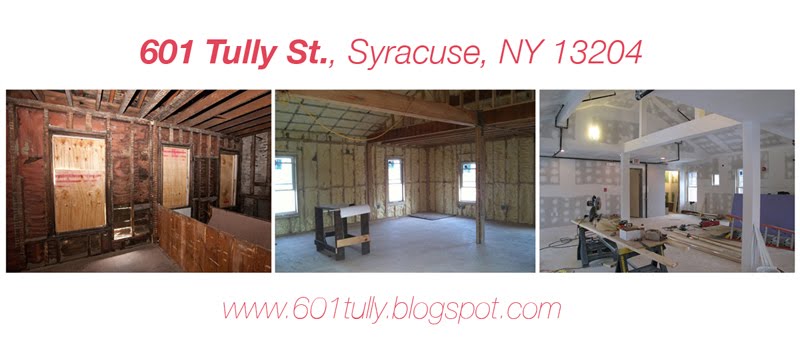
In 2009, Wilson purchased the condemned two-story home and local drug hub, and throughout five semesters, Wilson's design/build class re-zoned, designed, renovated and now sustains the physical and programmatic aspects of 601 Tully. The collaborative team has consisted of artists, architects, environmentalists, Fowler High School students, Green Train Workforce, neighbors, and the occasional passerby.

601 Tully is made possible by the generous support of the Syracuse University School of Education, The Kauffman Foundation, The Near West Side Initiative, Imagining America, Home HeadQuarters Inc., Say Yes to Education, and National Grid.

Find us on Facebook!

Wednesday, June 8, 2011

Richard Serra Inspired Community Garden

Here are some (incoherent) notes on Serra and gardening:

Serra is considered a part of Postmodernism, and post-minimalism/process art (process and materials made explicit in final product), objects being about what they are: wood is wood, steel is steel, they are aggressively their material. Their construction is also true to their material. Things like joints, clips, gluing, welding, etc. falsify the impression of the real balance and weight of the materials. Serra’s work forces itself uncomfortably on the viewer. They dictate paths around them, incite fear and danger. The steel walls overpowers anyone in range. I don’t think this aggressive nature of the work would be ideal in a community garden, but, I think we can take cues from his unapologetic approach to creating. The materials we find and utilize will be unapologetically themselves, and, if we tie in this aesthetic with the permaculture, the raised garden beds and placement will be designed with the permaculture ideology in mind. I like that the ramp largely cuts into the garden area, because it already brings to mind some of Serra’s work, in that it is defensively itself; it forces the viewer to deal with its presence, to walk around it, etc.

If Serra’s goal was to force the viewer to deal with his artwork in a public space, and he aggressively pursued and designed that goal, and we can take from him that if our goal is to provide a comfortable sitting area/garden for the community, then we will pursue that as unapologetically as he did his goals, and the materials we use will be true to their own materiality.

The visual tie between Serra’s work and permaculture gardening can also be seen in the raised bed gardens.Many of Serra’s pieces look like some of the spiral or keyhole gardens that have been scaled up and stripped of their foliage and dirt. Even if we don’t fully utilize the benefits of keyhole & spiral gardens, I like the aesthetic of them, and how they relate to Serra’s sculptures. Also, Serra's drawings reminded me of vertical gardens, which I think would be a great way to add privacy to the west side of the lot, between the building and our neighbor.

Permaculture: sustainability, low maintenance, little waste, overall planning to solve problem (bigger picture), allowing the land and plants/life to do what they naturally do (growing patterns, etc.) and having that feed into other parts of the implemented design.

Permaculture is an approach to designing human settlements and agricultural systems that are modeled on the relationships found in natural ecologies. Permaculture is sustainable land use design. This is based on ecological and biological principles, often using patterns that occur in nature to maximize effect and minimize work. . Elements in a system are viewed in relationship to other elements, where the outputs of one element become the inputs of another. Within a Permaculture system, work is minimized, "wastes" become resources, productivity and yields increase, and environments are restored. Permaculture principles can be applied to any environment.


A link for an image-only powerpoint is here.

A PDF on keyhole gardens is here.

Tuesday, June 7, 2011

Garden Design: Wolfgang Laib


Wolfgang Laib is an artist interested in the materials of nature: pollen, milk, marble, beeswax-- materials he did not create. He uses these materials in concentrated forms, and by doing so, he abstracts them; he calls attention to them not as they are in nature, but as they are outside of the context of nature. In this way, his art honors the purity and beauty of the natural substance. He is also interested in serenity, in ritual. The collection of pollen for his pieces is both painstaking (taking months for a small bottle) and meditative. Similarly, his milkstones (white marble with a slight depression that is filled with milk) have to be emptied and refilled slowly each day, a ritual that endures in the hands of museum staff when he is gone.

A garden in and of itself, the human ordering of organic materials for beauty and peace, and the ritualistic care a garden needs, matches up with Laib's principles. So we can't really go wrong. In designing a conceptual garden that aligns a little more specifically with Laib, I was interested in creating that sense of serenity. Rather than having many loud colors, I suggested committing to a very simple color palette for both our flowers and the structures we have in the garden, e.g. the boards for the raised beds, the fence, and planters. I suggested that we paint as much as we can white in an attempt to create the equivalent of an outdoor gallery space. One concentrated area of color at the heart of the garden (I was thinking of a monochromatic raised garden bed, possibly yellow) would then create a focal point, inspiring calm contemplation. Paths and seating around the bed would encourage people to use the garden as a place of respite. In future years, the white structures could be repainted by the neighborhood children or the next group of students. This concept for the garden, like many of Laib's pieces would be fragile, ephemeral, and could give way to future visions of the garden.

I also suggested an area where children could play with some of the materials Laib would approve of--whether it's sand or rice or dried beans.


Friday, June 3, 2011

Art and nature are inseparable.


Diagram: Mel Chin's "Revival Field"


Art might not seem real when viewing pieces and/or
performances in a gallery of museum, via the everyday experience of
the landspace at 601 Tully the arts (and the all the dialectical
possibilities that grow out of them) become exquisitely real to the
people living on Syracuse's Near Westside. The project is an
alchemical work of modern art, ecology and community engagement.

To begin to solve the current state of the garden space, I propose soil testing and the installation of a 3’ x 3’ working bioremediation of the soil in situ, via phytoextraction processes that are appropriate. This “Foundation: Flux”, along with the construction of raised beds and container gardens will create a functional and aesthetically pleasing use of the 30’ x 30’ landscape behind the mahogany ramp attached to the building. The intention is to make a physical investment in the actual terra firma of the Near Westside that will also introduce the invigorating concepts of soil as artistic medium and “plants as sculpture” as displayed in the work of the contemporary conceptual artist Mel Chin. “Sculpture as an evolutionary process” is a lens through which to approach the 601 Tully re-vitalization project and in terms of this, an homage to “Revival Field: Projection and Procedure” is very apropos. “Foundation: Flux” will be a testament to the creative work that is in a long-term state of improvement.

Much smaller in size than “Revival Field” but just as concerned with stewardship and site-specificity “relates to my interest in alchemy and my understanding of transformative processes and the mutable nature of materials. The contaminated soil is transformed back into rich earth, capable of sustaining a diverse ecosystem.” A scaled down version of Mel Chin’s project along with the raised beds, will indeed project the fact to residents that 601 is a danger zone no more.

Potentials for the site: used by students from Blodgett and other visiting educational groups as a practicum site (and as an ongoing homage to “Revival Field” and Mel Chin as a politically engaged artist). Bringing (col)laboratory skills to use outside. Local experts will to teach and train students in sustainable ecology, political ecology, and/or eco-art. An extension of the “Art, Ecology and Community” course, in effect, blurring any institutional boundaries.

Furthermore, I propose that the site be used to train youths for jobs and internships in the green industry by showing them how to take proper soil samples as well as the harvesting, drying, incineration and analyzing of the plants used in remediation. This view also recalls Joseph Beuys’ statement on the “nature” of his art not being “fixed and finished processes continue..” Both Beuys and Chin are artists who use earth as the medium, as prima materia (universal). There are scores of others who make art out of the earth. In terms of authorship, 601 Tully will have multiples.

“Plants are the new sculpture” Mel Chin, 1989. Situated in the Pig’s Eye Landfill in St. Paul, MN, another one of America’s Superfund sites (styes), “Revival Field” 1990-1993 grew out of Mel Chin’s desire to “carve away” at the earth as a traditional sculptor would use a reductive process to chisel wood or marble. The piece is a 60 square foot section of landfill that is being bioremediated via phytoextraction using several different hyperaccumulating species of plants, including a plant sacred to the Iroquois of the Northeast--sweet corn. Chin, seems to have been fascinated by jimsonweed originally; however, under the guidance of the botanist Rufus Chaney, discovered other dynamic accumulator species work best to remedate, Alpine pennycress being the best working species for “Revival Field”.

One species that would be useful at the 601 Tully site is comfrey Symphytum officianalus. Widely mistaken as a loathsome “weed”, it almost gets a bad wrap, for not only is it very medicinal and nutrient dense it also works in the garden as a nutrient fixer, biomass builder and a living fertilizer. Its foliage and flowers are aesthetically interesting and child friendly, as a perennial it will be a very sustainable and low maintenance plant. Symphytum officianalus along with other plant varieties such as sunflowers, chickweed, and clovers will provide a quilt of examples for experts to instruct students on how they may safely make use of the soil and different uses of plants growing wild here in the area that they might otherwise not be privy to. I have included a diagram of the “Flux Foundation” design that recalls “Revival Field” yet is also based on a quilt designed by the local fiber artist Caroline Tauxe entitled, “Coming Home--All Our Relations” it is made up of concentric circles divided from the center into quadrants, sort of like a miniature “quad” and representative of the “cycles and inter-related elements that make up our world.” (I haven't scanned that drawing for this post, will add it soon...)

Here is a sustainable system that will not only restore biodiversity and harmony to the area but also restores the health of the soil medium, a return to it’s ideal state for optimal growth. Working with soil/land as the medium, like Beuys, De Maria, Ana Mendieta, Rikrit Tiravanjia, Jean-Luc and Titi Parant-- Chin is also interested in alchemical forms of art, “the meaning is determined by matter.” He is also inspired by the experience of habitats, cross cultural exchange,scientific analysis, botany--multiple disciplines. Interesting to note that Mel Chin is the product of a pluralist environment growing up first generation Chinese in a diverse, urban neighborhood in Houston, Texas with a lot in common to the Near Westside

“Earth is what has been hidden by urbanism, what has been washed away by modern sanitation, what has been forgotten by people oblivious to the support systems they live within; it isnt surprising that it has reemerged as art.” R. Solnit


Further reading:
The Contingent Object of Contemporary Art, Martha Buskrik, 2003

Fragile Ecologies: Contemporary Artists’ Interpretations and Solutions, Barbara C. Matilsky,1992

As Eve Said to the Serpent: On Landscape, Gender, and Art. Rebecca Solnit, 2001

“Ecological Restoration: Mel Chin, Revival Field.” Don Krug. www.greenmuseum.org

Thursday, June 2, 2011

Native Plant Links

http://nativeplantcenter.org/plantlist.htm

Helpful EPA Web Links

NSCEP/NEPIS - EPA's Gateway to Free Digital & Paper Publication: www.epa.gov/nscep
7,000 in stock and 35,000 digital publications are available through the National Service Center for Environmental Publications (NSCEP), and the EPA's National Environmental Publications Internet Site (NEPIS) database! Search, retrieve, download, print and/or order EPA publications from this site.


EPA: Greenscapes: http://www.epa.gov/epawaste/conserve/rrr/greenscapes/owners.htm

EPA Greenscape activities (addresses soil compaction):http://nepis.epa.gov/Exe/ZyNET.exe/P1006AMI.txt?ZyActionD=ZyDocument&Client=EPA&Index=2006%20Thru%202010&Docs=&Query=530F09025&Time=&EndTime=&SearchMethod=1&TocRestrict=n&Toc=&TocEntry=&QField=pubnumber%5E%22530F09025%22&QFieldYear=&QFieldMonth=&QFieldDay=&UseQField=pubnumber&IntQFieldOp=1&ExtQFieldOp=1&XmlQuery=&File=D%3A%5CZYFILES%5CINDEX%20DATA%5C06THRU10%5CTXT%5C00000015%5CP1006AMI.txt&User=ANONYMOUS&Password=anonymous&SortMethod=h%7C-&MaximumDocuments=10&FuzzyDegree=0&ImageQuality=r75g8/r75g8/x150y150g16/i425&Display=p%7Cf&DefSeekPage=x&SearchBack=ZyActionL&Back=ZyActionS&BackDesc=Results%20page&MaximumPages=1&ZyEntry=3#

EPA: Urban runoff: http://nepis.epa.gov/Exe/ZyNET.exe/20004PP1.txt?ZyActionD=ZyDocument&Client=EPA&Index=1995%20Thru%201999%7C1976%20Thru%201980%7C2006%20Thru%202010%7C1991%20Thru%201994%7C2000%20Thru%202005%7C1986%20Thru%201990%7C1981%20Thru%201985%7CPrior%20to%201976&Docs=&Query=urban%20gardens%20&Time=&EndTime=&SearchMethod=2&TocRestrict=n&Toc=&TocEntry=&QField=&QFieldYear=&QFieldMonth=&QFieldDay=&UseQField=&IntQFieldOp=0&ExtQFieldOp=0&XmlQuery=&File=D%3A%5CZYFILES%5CINDEX%20DATA%5C00THRU05%5CTXT%5C00000007%5C20004PP1.txt&User=ANONYMOUS&Password=anonymous&SortMethod=-%7Ch&MaximumDocuments=15&FuzzyDegree=0&ImageQuality=r85g16/r85g16/x150y150g16/i500&Display=hpfr&DefSeekPage=x&SearchBack=ZyActionL&Back=ZyActionS&BackDesc=Results%20page&MaximumPages=1&ZyEntry=1


Beneficial Insects:
Plants to attract beneficial Insects: http://nativeplants.msu.edu/pdf/E2973.pdf

Youtube Info from Christopher Shein, Permaculture Teacher & Author:
http://www.youtube.com/watch?v=sgkst4m_z_g&feature=player_embedded (his food forest)
http://www.youtube.com/watch?v=5tw78MfIFlM&feature=player_embedded (his permaculture class)
http://www.youtube.com/watch?v=5tw78MfIFlM&feature=player_embedded#at=434 (including: comfrey root fertilizer)
http://www.youtube.com/watch?v=FKi8uXNbP7k&feature=player_embedded (tour of his yard)

Native Plant Information: www.nativeplantcenter.org