About 601 Tully
Check out our new website! 601Tully.syr.edu
601 Tully is a center for engaged practice in Syracuse, NY developed by artist and professor Marion Wilson with a rotating collaborative team of 54 students and neighbors and Anda French of French 2Design. It's a site for meaningful exchange between artists, community members, and scholars in the co-production of culture.
601 Tully includes a contemporary art space, a public events space, a bookstore, a teaching garden, and Recess Cafe West.
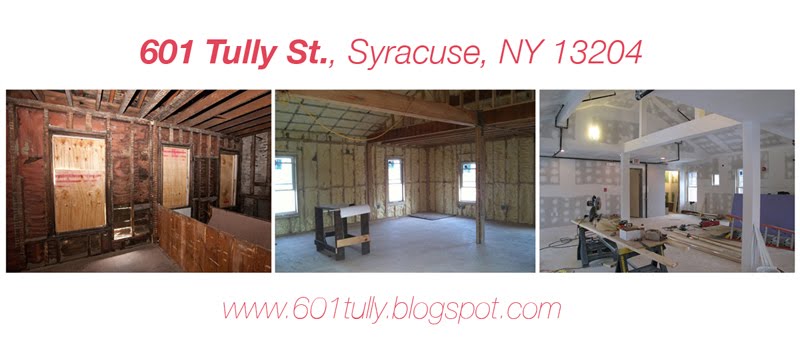
In 2009, Wilson purchased the condemned two-story home and local drug hub, and throughout five semesters, Wilson's design/build class re-zoned, designed, renovated and now sustains the physical and programmatic aspects of 601 Tully. The collaborative team has consisted of artists, architects, environmentalists, Fowler High School students, Green Train Workforce, neighbors, and the occasional passerby.
601 Tully is made possible by the generous support of the Syracuse University School of Education, The Kauffman Foundation, The Near West Side Initiative, Imagining America, Home HeadQuarters Inc., Say Yes to Education, and National Grid.
Find us on Facebook!
Wednesday, December 22, 2010
Beauty and Goodness
Monday, December 20, 2010
Butterfly House Project

Saturday, December 18, 2010
Coffee Table
Wednesday, December 15, 2010
Tyree Guyton Inspiration for a 601 Tully Garden
Tyree Guyton's start as an artist came with his creation of the Heidelberg Project (http://www.heidelberg.org/), a site in Detroit that cleaned up a neighborhood through the collection of trash and re-appropriation of that trash into a large scale art piece. The project has expanded since to include educational and youth programs, as well as being the site from which other community improvement projects are formed. Visual vs. Physical Engagement of Community
In reference to the Bloomtown project presented by Tony, I was also very disappointed in its attempts to call itself a community engaging piece. The problem with it is that it is merely an “art piece,” it is a visually stimulating/engaging. What is different about the 601 Tully project is that while it aims to become a visual art piece in the community, it also adds a layer of physical engagement. Not only does it propose a community art space upon its completion, it interacts with the community on different levels with the community throughout its construction process (for example: the wall drawing and floor poems). In this way I agree with John’s categorization of 601 Tully as Kwon’s “Invented Community” because 601 Tully is process of community interactions/relationship,s rather than a static art piece that only attempts to visually stimulate its community.
A way in which a project such as the Bloomtown project could be furthered to be not only a visually, but also physically engaging project for the community like 601 Tully. To succeed in this an example proposal that could add that additional layer of engagement can be created creating a set of wire-frame furniture within the “flower plans” that could be used to grow food for the nearby residents. By incorporating an element, food, that is necessary and is actually lacking for the nearby residents, the Bloomtown project will find itself as both the visually and physical engaging project that makes 601 Tully a social art project.
Interestingly while we were in Detroit, we were also able to visit the Heidelberg Project by Tyree Guyton, the artist and inspiration I used for my proposed garden at 601 Tully. The Heidelberg Project is also a good example of a social art project that engages the community at a scale of community involvement that I believe 601 Tully is eventually aiming for in the Near West Side.
Outside the classroom I have a tendency not to engage with projects such as 601 Tully. In a way the reason I signed up for the course was to understand how to become involved using my skill sets, rather than relying on a title (such as those we discussed with text between the architect and artist) to define me to a specific role in such projects. I feel this class has opened up my understanding that there are opportunities to positively engage with the community and they are easier to become a part of than I thought before. I hope to become more community aware through my design processes.
In addition, we also considered some other interior elements that could be used by children.

